- Electrical Passive Components Products
- sku: 4152762108787713
- OHMITE RLS10R
RLS10R OHMITE Potentiometer Rheostat
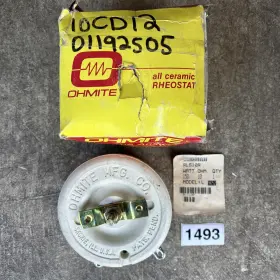
| Brand | OHMITE |
|---|---|
| Manufacturer Part Number | RLS10R |
| Power Rating | 150 W |
| Series | RLS |
| Type | LINEAR RHEOSTAT |
| Termination Style | LUG |
Review OHMITE Potentiometer 10 Ohm 150w Rheostat 150 Watt
The Ohmite RLS10R potentiometer is a versatile and high-performing rheostat designed for various industrial applications. This 10-turn, linear, carbon composition potentiometer boasts a power rating of 150 watts, making it suitable for handling significant power loads.
The RLS10R potentiometer features a resistance range of 10 ohms, with a precision of 20%. This means that the resistance value at the wiper can be adjusted between 8 and 12 ohms with a reasonable degree of accuracy. The potentiometer's carbon composition construction ensures stable and consistent resistance values over time, even under heavy usage.
The rheostat has a robust, compact design, with a length of approximately 3.5 inches (89mm), a width of 1.5 inches (38mm), and a height of 1 inch (25mm). The rugged, epoxy-coated housing provides excellent protection against environmental factors, such as moisture, dust, and impact. The RLS10R also comes with a threaded shaft and a knob for easy and precise adjustments.
This potentiometer is designed for high current applications, and it can handle up to 15 amps at 10 volts. It has a maximum operating temperature of 125 degrees Celsius (257 degrees Fahrenheit), ensuring reliable operation even under extreme conditions.
The Ohmite RLS10R potentiometer comes with a BNC-style terminal block for easy wiring and connection to other components. It also includes a 3/4 inch mounting hole for easy installation in various applications. Additionally, it is RoHS compliant, ensuring that it meets the latest environmental regulations.
Overall, the Ohmite RLS10R potentiometer is an excellent choice for industrial applications requiring a high-power, adjustable resistance component. Its robust construction, stable resistance values, and high current handling capability make it a reliable and versatile addition to any system.
The Ohmite RLS10R potentiometer and 150W rheostat are electrical components commonly used in various applications such as power control and voltage regulation. Let's discuss the pros and cons of buying each component separately.
Ohmite RLS10R Potentiometer: Pros:1. High Power Rating: The RLS10R potentiometer can handle a power of up to 150 watts, making it suitable for high power applications.
2. Wide Operating Temperature Range: The potentiometer has a temperature range of -65 C to 155 C, which makes it suitable for use in various environments.
3. Good Resistance Values: The RLS10R potentiometer offers resistance values from 1 ohm to 10 megohms, providing flexibility for different applications.
4. Rugged Construction: The potentiometer is built with a rugged, heavy-duty design, which ensures durability and long life.
Cons:1. Size and Weight: The RLS10R potentiometer is larger and heavier than some other types of potentiometers due to its high power rating and rugged construction.
2. Cost: The potentiometer is more expensive than lower-power alternatives due to its high power rating and rugged construction.
150W Rheostat: Pros:1. High Power Rating: The 150W rheostat can handle a power of up to 150 watts, making it suitable for high power applications.
2. Adjustable Resistance: The rheostat provides adjustable resistance, allowing for precise control of the electrical current.
3. Rugged Construction: The rheostat is built with a heavy-duty design, ensuring durability and long life.
4. Wide Operating Temperature Range: The rheostat has a temperature range of -40 C to 85 C, making it suitable for use in various environments.
Cons:1. Size and Weight: The 150W rheostat is larger and heavier than some other types of rheostats due to its high power rating and rugged construction.
2. Cost: The rheostat is more expensive than lower-power alternatives due to its high power rating and rugged construction.
Conclusion:Both the Ohmite RLS10R potentiometer and 150W rheostat offer high power ratings, rugged construction, and versatile applications. However, they are larger, heavier, and more expensive than their lower-power counterparts. The decision to buy either component depends on the specific requirements of your application and the available budget.
If you need precise voltage or current control, the potentiometer may be the better choice. On the other hand, if you need to adjust the resistance in a high power application, the rheostat may be the better choice. Ultimately, consider the specific requirements of your project and weigh the pros and cons of each component before making a purchase.
Details:
New old stock. Fast free shipping.
specifications passivecompos:
- brand: Ohmite
- mpn: Rls10r
- power rating: 150 W
- series: Rls
- type: Linear Rheostat
- termination style: Lug
returns passivecompos:
- policy: no returns
seller passivecompos:
- city: oregon city, oregon
- # reviews: 380
- rating: 98.8%
offer passivecompos:
- options: ship-to-home
- availability: in stock
- in stock #: 2
- prices: $96.00–$112.00
- item condition: New – Open box
- started: january 21, 2026
- sold #: 9
- best offers: true
shipping passivecompos:
- transit: 3-9 days
- carrier: ups, usps
- class: standard, expedited
- service: ups ground, usps priority mail
- type: fixed
general passivecompos:
- category: Business & Industrial > Passive Components > Potentiometers Variable Resistors > Rheostats
payments passivecompos:
- credit card: discover
- wallet: google-pay
- other
Similar Items:
- Ohmite Cu5052 Usa Potentiometer Cu 5052 Type Ab Taper U Linear 2 Watt 5.0megohm Vintage Solder ends are clean. Shaft is 2 inch long including thread. Used, tested...(December 25th, 2023)
- Ohmite 0569 500 Ohms Divid Ohm Vitreous Enameled Resistor tested Used, but adjusts and works fine as seen in photos. Most of my electronic related parts were acquired through an elderly electrical engineer who was downsizing to move out state. Many of his hundreds parts that I acquired were military air force related from the 1960 S. Ohmite 0569 500 ohms ...(December 27th, 2023)
- Ohmite 0541-500 Rheostat 500 Ohms Please see pictures for details and condition. Used and in good condition. Please review the pictures to make sure part number match item you are looking replace...(January 17th, 2024)
- Ohmite Cu-1021 Cu1021 Potentiometer 1k Ohm With Wire Part #: Ohmite CU-1021 for sale...(January 18th, 2024)
- Ohmite 39235 Variable Rheostat potentiometer 39235 1000 Ohms New cords installed and the rivets were replaced with screws. Part number 39235. Used Ohmite rheostat/potentiometer. Max ohms is 1000 at .16 amps. Its been tested and is in good working order...(February 3rd, 2024)
- Ohmite Rrs25r Lot Of 3 Vintage Rheostat Variable Resistors Lathe Welder Large Power Knobs turn smooth. As-is untested...(February 3rd, 2024)
- Ohmite 1ro P n Rks Rheostat Ohmite - p/n: KS 1RO rheostat...(February 28th, 2024)
- Ohmite Cu-1041 Type Ab 1 Meg Ohm 100 K 3 Pot Potentiometer vintage S:// .arrow /EN/PRODUCTS/CU1041/OHMITE. I do basic simple tests to see if an item works. Rotation 312 degree, /-3%, 500V. Note: mount: panel.: tested as seen in photos. Real deal Neal. Please place items in cart. These items are used and due to the age in most cases vintage stuff. Will pack and ship...(March 14th, 2024)
- Ohmite 0144 No Series A Rheostat Potentiometer 300v Part #: Ohmite 0144 for sale...(March 21st, 2024)
- Ohmite Rhs6r0 Rheostat Sale It is a great option for those who are looking potentiometer or variable resistor their electrical equipment. The brand, Ohmite, is well-known for producing reliable and durable electronic components...(April 11th, 2024)
- Ohmite 0161 Rheostat 3500 Ohms Mara industrial id: 44, Ohmite 0161 rheostat 3500 ohms - used, pn: 0161, res 8140...(April 16th, 2024)