- Electrical Passive Components Products
- sku: 4338303877957772
- MEMCOR R12.5-500
R12.5-500 MEMCOR Potentiometer Rheostat
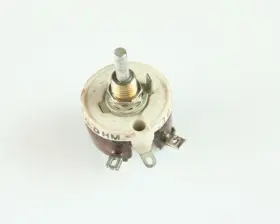
| Brand | MEMCOR |
|---|---|
| Manufacturer Part Number | R12.5-500 |
| Mounting Style | PANEL MOUNT |
| Power Rating | 12.5 WATT |
| Type | LINEAR TAPER POTENTIOMETER |
| Termination Style | LUG |
| Material | CERAMIC |
| Country Of Origin | UNITED STATES |
Review MEMCOR Potentiometer 500 Ohm Rheostat 12.5 Watt
The Memcor R12.5-500 potentiometer is a high-performance rheostat designed for applications requiring precise voltage regulation or current limitation. With a power rating of 12.5 watts, this potentiometer can effectively handle moderate power loads. It boasts a 500-ohm resistance value, making it suitable for use in circuits where a significant voltage drop is desired.
This Memcor potentiometer features a carbon composition resistive element, which offers excellent stability and linearity over a wide temperature range. Its resistance value is fixed at 500 ohms, ensuring consistent performance and reliability. The wiper is made of beryllium copper, providing superior conductivity and wear resistance.
The R12.5-500 potentiometer comes with a rotary knob, allowing for easy and accurate adjustments. The knob is mounted on a durable, heavy-duty aluminum housing that provides excellent heat dissipation capabilities. The housing is also sealed to protect the internal components from dust and moisture.
This potentiometer's resistance value is stable over a wide temperature range, making it well-suited for use in various industrial and commercial applications. Its high power rating and robust construction make it an ideal choice for applications where precise voltage regulation or current limitation is crucial.
In summary, the Memcor R12.5-500 potentiometer is a versatile and powerful rheostat with a 500-ohm resistance value, 12.5-watt power rating, and a durable, heat-dissipating aluminum housing. Its carbon composition resistive element offers excellent stability and linearity, making it an excellent choice for applications requiring precise voltage regulation or current limitation.
Membranic R12.5-500 Potentiometer and 12.5W Rheostat: A Comprehensive Analysis
The Membranic R12.5-500 potentiometer and 12.5W rheostat are adjustable electrical components commonly used in various applications, such as voltage regulation, current limiting, and power control. In this analysis, we will discuss the advantages and disadvantages of these components to help you make an informed decision about purchasing them.
Membranic R12.5-500 Potentiometer: Pros:1. Wide resistance range: With a resistance range of 12.5 ohms to 500 ohms, this potentiometer offers versatility for numerous applications.
2. Membrane technology: Membrane potentiometers are known for their stable and uniform resistance, which ensures consistent performance and accurate readings.
3. Easy to use: Potentiometers are simple to install and operate, allowing users to easily adjust the resistance value and fine-tune their applications.
Cons:1. Limited power handling: With a maximum power rating of 12.5 watts, this potentiometer may not be suitable for high-power applications.
2. Linear response: Membrane potentiometers have a linear response, meaning their resistance value changes proportionally to the angle of rotation. This might not be ideal in some applications where a non-linear response is required.
12.5W Rheostat: Pros:1. Power handling: With a power rating of 12.5 watts, this rheostat is suitable for applications that require high power handling capabilities.
2. Manual adjustment: Rheostats provide manual resistance adjustment, enabling users to adjust the flow of current in real-time.
3. Versatile: A 12.5W rheostat can be used in various applications, including voltage regulation, current limiting, and power control.
Cons:1. Limited resistance range: With a limited resistance range, this rheostat might not be suitable for applications that require a wide range of resistance values.
2. Heating: As a resistive component, rheostats generate heat when in use, which could potentially affect the performance and lifespan of sensitive components.
Ending Conclusion:The Membranic R12.5-500 potentiometer and 12.5W rheostat each have their unique advantages and disadvantages. The potentiometer offers a wide resistance range, stability, and ease of use, but has limited power handling capabilities. The rheostat, on the other hand, provides high power handling capabilities and manual resistance adjustment but has a limited resistance range and generates heat when in use.
When deciding between the two components, consider the specific requirements of your application, such as the resistance range, power handling capabilities, and the desired response type (linear for the potentiometer or non-linear for the rheostat).
If your application requires a wide resistance range and linear response, the Membranic R12.5-500 potentiometer would be the better choice. However, if you need high power handling capabilities and manual resistance adjustment, the 12.5W rheostat would be more suitable.
In conclusion, the decision to purchase the Membranic R12.5-500 potentiometer or 12.5W rheostat depends on the unique demands of your application. Carefully evaluate the specifications and advantages of each component to ensure that you select the one that best meets your requirements.
Details:
Bushing1/4, shaft 3/8.
specifications passivecompos:
- brand: Memcor
- mpn: R12.5-500
- mounting style: Panel Mount
- power rating: 12.5 Watt
- type: Linear Taper Potentiometer
- termination style: Lug
- material: Ceramic
- country of origin: United States
returns passivecompos:
- paid by: seller
- time: 30 days
- policy: returns accepted
- method: money back
general passivecompos:
- category: Business & Industrial > Passive Components > Variable Resistors > Potentiometers
shipping passivecompos:
- class: standard
- type: calculated
- carrier: usps
- transit: 4-10 days
- service: usps ground advantage
seller passivecompos:
- # reviews: 712
- city: north charleston, south carolina
- rating: 100.0%
offer passivecompos:
- price: $49.00
- item condition: New – Open box
- options: ship-to-home
- best offers: true
- sold #: 11
- started: february 27, 2026
- availability: in stock
payments passivecompos:
- credit card: diners-club
- other
- wallet: paypal
Similar Items:
- Memcor 8440 2 Pcs Fr10 Resistor 100 Ohm 10w Products most of our photos are the actual item you purchasing. Unless stated otherwise in the listing. Defective items may only be exchanged for the same title. Please refer to the photos. 2 PCs Memcor 8440 FR10 resistor, 100 ohm 10W...(January 21st, 2024)
- Memcor 9346 200 Ohm 35 Amp Rheostat potentiometer Vintage used potentiometer/rheostat as shows in the pictures...(June 14th, 2024)
- Memcor 719500-01 Type R-75 Potentiometer Pn 6.12a Used Memcor type R-75 potentiometer pn 719500-01, 6.12A, used...(December 22nd, 2024)
- Memcor R25-500 500 Ohm 25watt 1 2 Shaft 3 8 Bushing Reostat Potentiometer Manufactured by Memcor in the USA, this rheostat has a 1/2 inch shaft and 3/8 bushing for easy installation various electronic applications. The R25-500 Memcor linear rheostat is a 25-WATT device with resistance rating of 500. It features a single-turn adjustment with lug termination style, designed...(January 13th, 2025)
- Memcor M22 01-00171ub 250 Ohm 12.5w Rheostat Potentiometer 5905-00-078-5785 This product is designed with one turn and used in electrical equipment industrial applications. It is manufactured in the USA and comes bulk packaging. The M22/01-00171UB Memcor rheostat potentiometer is a 250 ohm, 12.5W linear rheostat with lug termination...(January 13th, 2025)
- Memcor M22 03-00241fd 5k Ohm 25w Rheostat 5905-00-108-6305 1/2 shaft length 3/8 bushing. This Memcor rheostat is a reliable component commonly used in various industrial and electronic systems. The M22/03-00241FD Memcor linear rheostat is rated at 25W with a resistance of 5 k and lug termination style. It is designed for applications where variable ...(January 13th, 2025)
- Memcor Rp102fd201kk 200 Ohm 25watt Reostat Potentiometer 5905-00-984-8588 The RP102FD201KK Memcor linear rheostat is a 200 ohm, 25 watt potentiometer with lug termination style. This rheostat, with part number 5905-00-984-8588, is a reliable choice for adjusting resistance levels in various industrial and electronic settings. 1/2IN shaft 3/8 bushing. The product is ...(January 13th, 2025)
- Memcor M22 03-00201fd 1k Ohm 25watt Reostat Potentiometer 5905-00-114-9970 The M22/03-00201FD Memcor linear rheostat is a 1 k, 25 w potentiometer with lug termination style. This single-turn rheostat is manufactured in the USA by Memcor and designed for use various electrical applications. 1/2IN shaft length 3/8 bushing. The rheostat is bulk packaged and ideal for ...(January 13th, 2025)
- Memcor Tfv0054-h2500-jaff 50 Ohm 50w 1a Rheostat With Switch 19 2 HIV model - p/n TFV0054-H2500-JAFF 50 ohm 50W 1a rheostat w/switch. Kept in a clean working environment. , model - P/NTFV0054-H2500-JAFF 50 ohm 50W 1a rheostat w/switch, conditioner in oem packaging. Only opened 1 for photos. Specifications...(January 21st, 2025)
- Memcor 2493-010-004 Rheostat Pointer Knob 3-3 8 Inch Diameter Handwheel 3 8 Shaft Multiple items can be combined to minimize your shipping expenses. Memcor rheostat pointer knob 2493-010-004 3-3/8 diameter hand wheel 3/8 shaft shaft: images. Hand wheel with brass bushing. Any cosmetic and/or operational defects are disclosed in the. Claims on all in warranty merchandise much be ...(February 4th, 2025)
- Memcor 2493-010-003 Rheostat Knob 3-3 8 Inch Diameter Handwheel 3 8 Shaft Nos Multiple items can be combined to minimize your shipping expenses.: this listing is for a genuine Memcor rheostat knob. Any cosmetic and/or operational defects are disclosed in the. Brand: Memcor, part #: 2493-010-003, dimensions: 3-3/8 diameter and fits 3/8 shaft set screw, condition: new old stock...(February 4th, 2025)